



A few days ago, Webflow laid off a significant portion of its workforce with no warning. Employees found out when they couldn’t log in to their work laptops or Slack for the day.
It was so bad that one employee posted this on LinkedIn, tagging the company CEO Linda Tong:
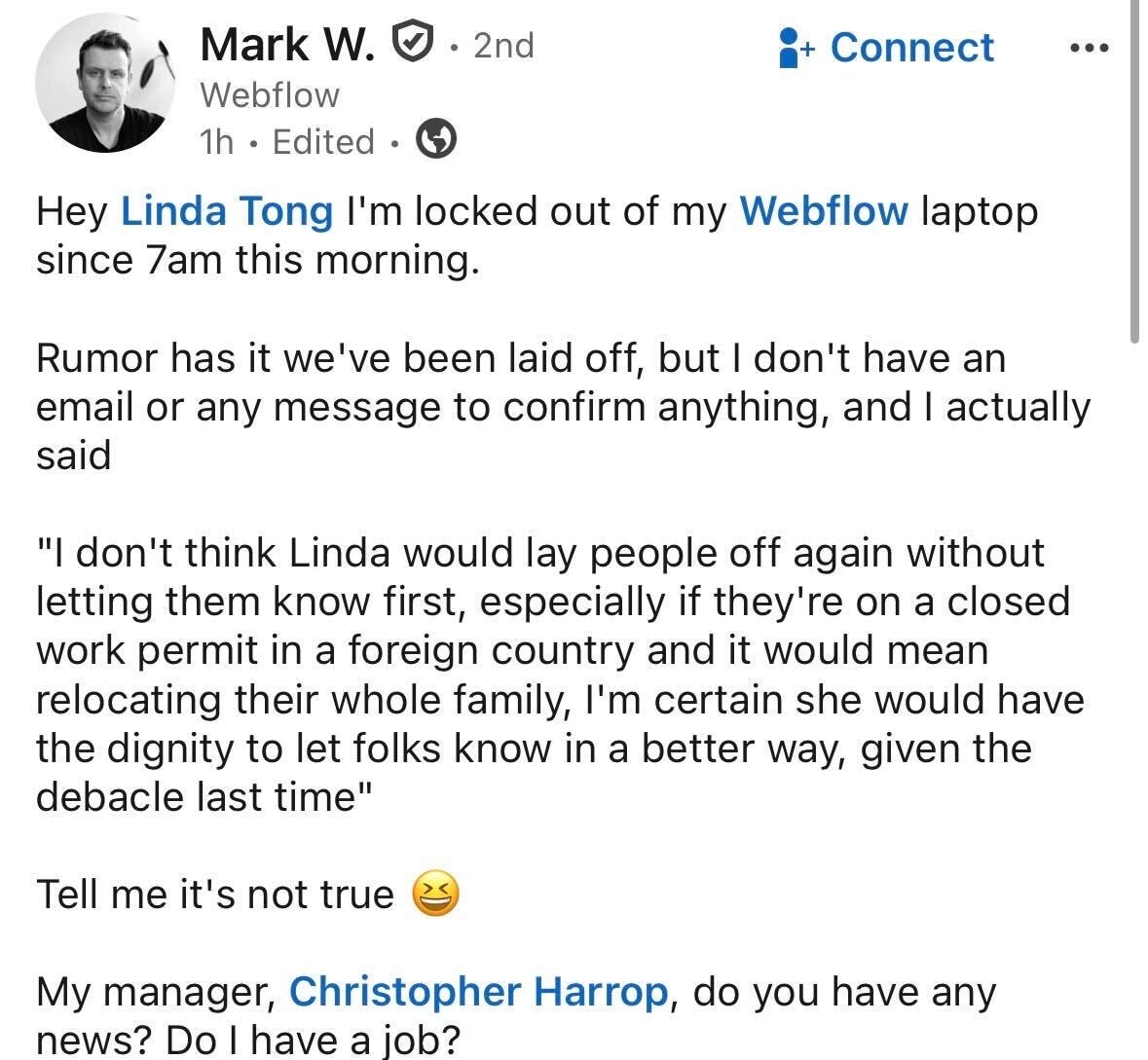
Webflow, a tool for designing websites, was once considered a great place to work. Now, it finds itself in the spewing the same BS that we hear from startups every few days: “Today, we’ve made the difficult decision to reduce the size of our workforce.”
It happens over and over. Abrupt layoffs repackaged as “restructuring” or “adapting to the world of AI.” Every time, the response follows the same script. We share the LinkedIn posts, we express outrage, we say, “This is horrifying.” Then we move on until the next company finds itself in the temporary spotlight when it makes a similar announcement.
And yet we keep not asking the obvious question: why does this keep happening?
The answer is brutally simple. The only reason this keeps happening in the U.S. is because nothing prevents it. Outside of unionized workers — which account for just 10% of the U.S. workforce — American employees are largely at-will. They can be fired at any time, for any non-discriminatory reason, with no notice and no severance required. We’ve built an entire employment system around the assumption that workers are disposable. All the power is held by the employer.
I’ve written before about how we underestimate the risks of traditional employment. The never-ending barrage of tech layoffs has proven to be one of the starkest examples of how this can play out.
What worker protections actually look like
I’ll frequently share screenshots like the LinkedIn post above. Without fail, someone will comment, “If you don’t like the way these companies function, start your own business.” (I did, as a matter of fact, but that’s not the point here.)
The power employers hold is a uniquely American experience, as is the idea that employees are entitled to nothing when their employer decides to cast them aside.
As part of my client work, I’ve spent a lot of time researching employment laws in other countries — particularly around how termination works. The contrast with the U.S. is striking.
Here are a few examples from my research.
Japan
Japan takes worker protections very seriously. Employees can only be dismissed for “objectively reasonable grounds.” Employers have to demonstrate they’ve done everything possible to avoid termination — document issues, offer performance improvement opportunities, consult with labor unions, consider reassignment — before resorting to it.
The standard notice period is 30 days (or 30 days’ pay in lieu). Japan even offers Employment Adjustment Subsidies to help companies retain workers rather than lay them off. (Imagine if that existed here.)
Netherlands
The Netherlands doesn’t allow at-will employment. Employers typically need permission from a government agency or a court to dismiss someone, and they need a valid reason. Notice periods range from one to four months depending on tenure, and employers are required to pay mandatory “transition compensation.”
Philippines
The Philippines has enshrined “security of tenure” in its labor laws. Employees can only be dismissed for legally recognized causes. For business-related reasons like redundancy, the employer must give 30 days’ written notice to both the employee and the Department of Labor. The employee is paid severance based on the length of their tenure.
South Africa
South African labor law requires dismissals to be both “substantively fair” (valid reason) and “procedurally fair” (proper process). For redundancy, employers must go through a formal consultation process — notifying affected employees, applying fair selection criteria, and considering alternatives to termination.
Turkey
Turkey requires valid reasons for all terminations, with notice periods ranging from two to eight weeks based on tenure. Employees with at least one year of service receive one month’s gross salary per year of service in severance. Pregnant employees, those on parental leave, and union representatives are protected from dismissal except in cases of gross misconduct or company closure.

This wouldn’t fly anywhere else
Every one of these countries requires a valid reason for termination. Most mandate weeks to months of notice. Most require severance. Several give employees the right to challenge their dismissal and be reinstated with back pay.
This is the polar opposite of U.S. at-will employment, where most workers can be let go at any time with no notice, no reason, and no recourse.
Japan’s framework is particularly striking when held up against what happened at Webflow. Japanese courts allow redundancy as a valid reason for dismissal, but with strict restrictions. Employers have to demonstrate a genuine business necessity. And they have to prove they did everything in their power to avoid a layoff first.
Now think about Webflow. Webflow said it was restructuring “because AI.” This is a company that has raised hundreds of millions of dollars in venture capital funding and had a $4B valuation in 2022. If AI truly was the reason (and that’s a generous reading), they could have chosen to do more with the same people. Instead, they chose to do the same with fewer people.
Under Japan’s labor laws, that argument would fall apart. Under the Netherlands’ system, they’d need government permission first. Under Philippine law, the dismissals could be invalidated for procedural failures alone (no notice period).
But in the U.S.? Nothing. No mandatory notice, no required severance, no mechanism for employees to fight the layoff. Hundreds (if not thousands) of employees have their lives upended. And once the company gets past the bad PR, they get to operate as they were before.
Power is 100% in the hands of the company. And when fear of a layoff becomes the driving force in how people think about their jobs, that’s not an individual problem. It’s a structural one.
These companies deserve to be publicly dragged. Because right now, nothing else is holding them accountable.
Thinking about a career change? Download my guide: 5 Types of Career Pivots.
If you want to support my work as a writer, you can subscribe to receive additional issues I publish.
Have a work story you’d like to share? Please reach out using this form. I can retell your story while protecting your identity, share a guest post, or conduct an interview.